
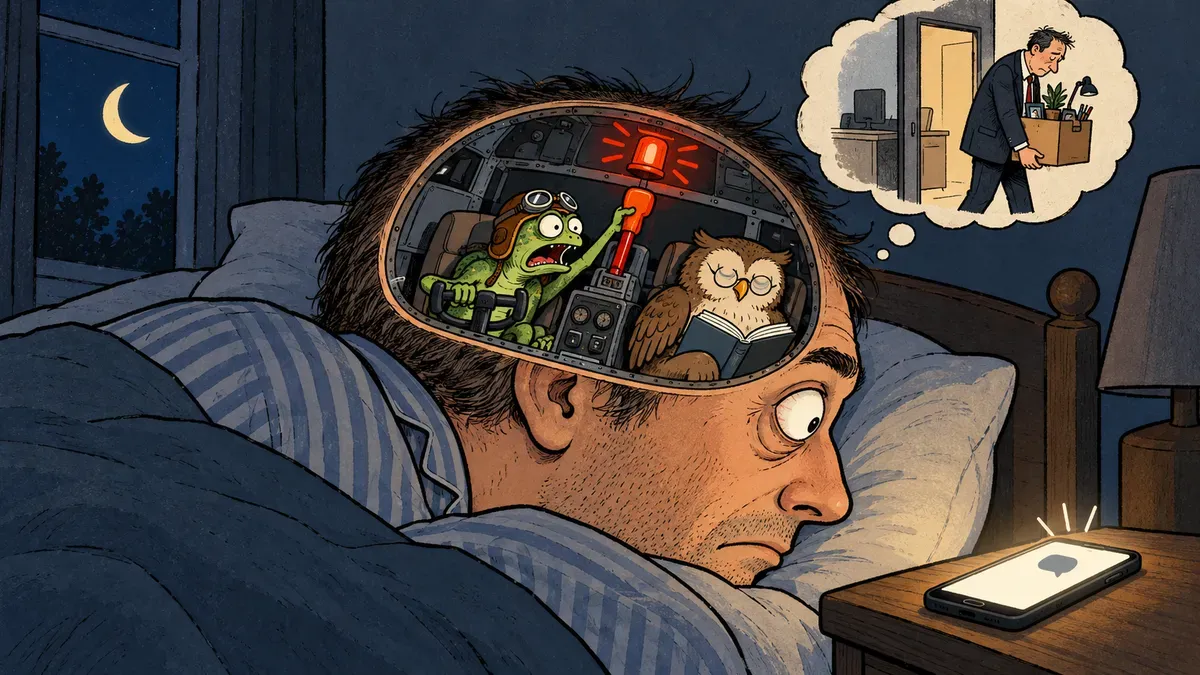
Your manager messages you “Let’s talk tomorrow” and nothing else. You spend the evening going over what you might have got wrong that day and rehearsing your defence, and you might even dust off your CV. The next morning it turns out they only wanted your opinion on a supplier.
You didn’t reason your way through that evening. A reflex did the deciding, one you learned who knows when. What got me thinking about where these reflexes come from was a book I was given a while ago, Jostein Gaarder’s Sophie’s World, a novel about the history of philosophy. When I reached the chapter on Freud, my brain did what it usually does when it’s working properly: it made connections. To a software engineer the unconscious looked familiar, a compressed and inaccessible version of what we have lived through, unreadable in plain form yet shaping everything we do. In machine learning, something similar is called a latent representation.
Freud was talking about desires, conflicts and repressed content, not compression, so as a theory of the unconscious it doesn’t hold. As a lens on how we work day to day, it does.
We don’t remember the past, we run it
Experience, then, is not just an archive we look things up in. It changes how we operate, much as the weights learned during training change a neural network. Little of the individual episodes survives; what survives are the patterns. In practice we become hyper-specialised, for better or worse, in the experiences we have most often, and we freeze at the edge of our comfort zone when faced with the ones we lack.
The trouble is that a pattern isn’t necessarily right. One strong experience, or a few that repeat the same way, is enough to turn a single case into a rule we then apply everywhere.
A dog that has been mistreated flinches when you raise your hand, even if you’re only reaching for the lead. It learned how to react somewhere else. When it’s afraid it either runs or bites, because the fight-or-flight response fires before thought has time to arrive. We’re no different, just better at explaining ourselves afterwards. At work, flight means going quiet and the bite is the sharp reply to an email.
Remembering is rebuilding
The machine learning analogy holds on another point too, and here it’s no longer just my own association. In 2024 two researchers at University College London proposed a model of memory built precisely on generative networks: the hippocampus records episodes quickly, then a second network replays them many times and extracts their structure, and from that structure the memory is rebuilt whenever it’s needed.1 It’s a model, not proof that the brain works this way, but it captures something psychology has known for a long time. Remembering is not playing back a recording, it’s regenerating it, and every time we regenerate it we rewrite it a little.
Emotion complicates things. Intense experiences leave a deeper mark, but not a more faithful one. The day after 9/11, researchers asked a group of students how they had heard about the attacks, then asked them again weeks and months later. Their accounts drifted as much as their memories of an ordinary day, while their confidence in remembering correctly stayed high.2 Vividness is persuasive. It guarantees nothing.
The filter at the door
There is a step that comes even before memory. We don’t record reality, we record what our senses let through, selected by attention and interpreted with everything we’ve already learned. And the system is recursive: who we have become decides what we notice, and what we notice confirms who we have become. Two people leave the same dinner with two different evenings in their heads, and neither of them is lying. So the error doesn’t only creep in when we remember. It’s already there while we look.
The bottleneck
In Thinking, Fast and Slow, Kahneman calls this fast, automatic thinking System 1. We need it, but it was trained in contexts that often no longer exist, and it keeps running on its own. It’s like driving in Britain with continental reflexes: excellent, if only we were on the right.
System 2, slow thinking, is supposed to keep it in check, but it takes effort to switch on and more effort to use, and we’re always running in power-saving mode. More often than not it just signs off on what System 1 has already decided.
Companies work the same way. “We’ve always done it like this” is an organisation’s System 1: procedures created for a constraint that may have disappeared years ago, which nobody touches because they feel like the natural way of working.
Why it’s easier to see from outside
A latent representation is unreadable to whoever looks at it, yet the system that uses it works with it perfectly well. For us it’s almost the other way round, and that’s the uncomfortable part: our motives are opaque to ourselves above all, because introspection runs through the very filters it is meant to examine. That’s why a friend, a partner or a psychologist sometimes sees what escapes us. They don’t read our minds. They watch what we do, spot the recurring patterns and form hypotheses, the way you would with a system whose code you can’t read. They can be wrong too, but they have one advantage we lack: they aren’t inside the data.
What to do with it
The first step is to put a small gap between stimulus and reaction, just enough for System 2 to switch on. Sometimes that means not replying straight away to the email that annoyed you. But the gap is worth little if System 2 then simply agrees with System 1. This is where philosophy and logic supply the missing piece, critical thinking, which questions the premises starting from the simplest question of all: what do I actually know, and what am I assuming?
It helps to treat the emotion as data and the explanation we give it as a hypothesis. In a good post-mortem after an outage, you write down the timeline of facts first, then the hypotheses, and never the blame. It works on ourselves too.
Nor do you need to find where a reflex comes from in order to change it, you only need to test it. If you think asking for clarification on a piece of criticism will make you look incompetent, ask anyway and see what happens.
The reverse is also true: you can build a convincing account of your own past and change nothing at all. Outside the office it happens all the time. “We need to talk”, from the person you live with, sets off the same reflex as your manager’s “Let’s talk tomorrow”, and knowing where it comes from doesn’t stop you spending the evening on the defensive. What actually shifts something is a new experience: asking, listening, and finding out that this time the prediction was wrong. That’s how the weights get updated.
Noticing
Being self-aware doesn’t mean reading yourself down to the last cog, something not even the professionals manage. It means noticing the moment the autopilot takes the controls, like that evening of “Let’s talk tomorrow”. That’s where, for the first time, we have a choice.
Footnotes
-
E. Spens, N. Burgess, A generative model of memory construction and consolidation, Nature Human Behaviour 8(3), 2024. https://doi.org/10.1038/s41562-023-01799-z ↩
-
J. M. Talarico, D. C. Rubin, Confidence, not consistency, characterizes flashbulb memories, Psychological Science 14(5), 455–461, 2003. https://doi.org/10.1111/1467-9280.02453 ↩