
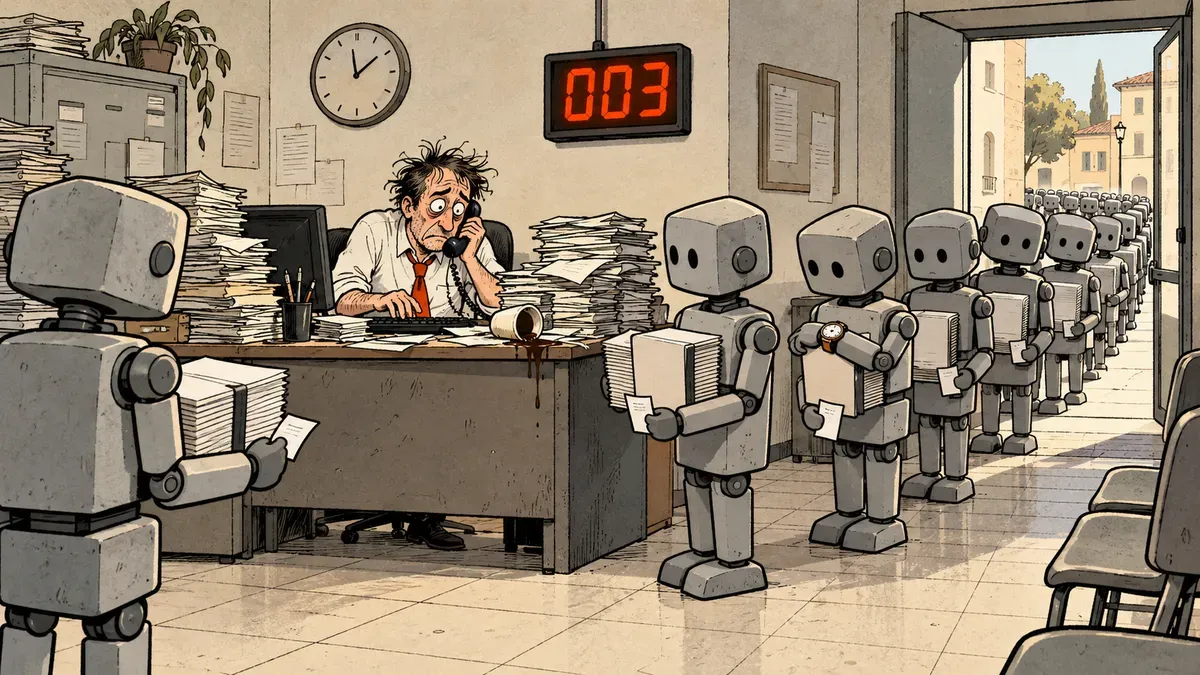
A task, a request to the AI, a few minutes of waiting. Before, we would have spent that time still working on the same thing; now part of the work is done by someone else and those minutes come free.
The natural thing to do is use them.
A lot of work used to follow a linear rhythm: decide what to do, do it, check the result, correct it and move on. AI compresses mainly the execution. The manual work shrinks, while the work of analysing, choosing and checking becomes more concentrated.
The problem comes when we try to reclaim that time as well. While the AI works on one thing we start another, then a third. Meanwhile the first is ready, so we go back, check it, ask for a correction and pick up what we had left. If the tasks are different, every switch means rebuilding a different set of goals, rules and constraints.
None of this is new. We have known for years that constantly switching tasks has a cost, that multitasking works badly and that interruptions break concentration. Things left half done also keep taking up attention: the research calls it attention residue, the part of our attention that stays on the previous task when we move on to the next.
An experiment on interruptions shows clearly where the cost can end up: the people who were interrupted finished the task faster and with no more errors, but reported more stress, frustration, time pressure and effort. Apparent productivity held up, while the cost moved onto the person.
With AI this mechanism speeds up. Output keeps coming while our attention spreads across more problems, and an agent can do a good job of what we asked without knowing about a constraint or a consequence we never explained to it. A small omission can produce a plausible solution, then more decisions built on top of it, until there is a cascade we only discover when we have to reconstruct what happened.
The countermeasures are well known. Before leaving a task, it helps to write ourselves a short handoff: where we got to, what we decided, what is left to check and what the next step is. Ready-to-resume plans, studied for interrupted tasks, reduce the interference of work left open.
We also need to limit work in progress, or WIP: the things we actually have under way. Having a lot to do does not mean having to keep it all active at once. The agents’ answers do not have to become new interruptions: they can wait until we decide to deal with them. And before delegating a complex problem we have to give the AI the context it needs: constraints, dependencies and consequences to check. If those are not clear, we rebuild the problem first and execute after.
Then there are the basics: cutting down notifications, doing one thing at a time when it needs concentration, stopping between one block of work and the next, getting up and walking. Micro-breaks reduce fatigue; on cognitively heavy tasks, though, a few minutes are not always enough to recover performance.
AI has not invented new problems at work: it has shifted the balance of problems we already knew. By taking time out of execution, it has increased the pressure on attention, memory and the ability to hold the context together.
The human system is the same as before. If we remove friction in one place without putting a limit back somewhere else, the cost does not disappear: it simply moves.
Originally published at https://www.corrierenazionale.net/2026/10/05/ai-produttivita-multitasking-attenzione/