
We ask AI agents more and more questions. When the job isn’t trivial we also give them context: the topic, the data, the goal, an example of what we want back, the constraints and what a job well done means to us. Sometimes we ask for a plan first, or for the questions they need answered, and then we hit send. And then, despite all the preparation, come the explanations, the corrections and the retries. It isn’t just my impression: in Stack Overflow’s 2025 survey of more than 49,000 developers, two in three named AI answers that are “almost right, but not quite” as their main frustration.1
I don’t know how often it happens to you, but I keep comparing the experience to working with a junior. With one difference: a junior, correction after correction, grows. The agent doesn’t. It only improves if I write the correction into its instructions, and that improvement stays with the agent.
That changes the bill too. What I teach a junior I pay for once, and from then on they carry that knowledge with them. The agent, on the other hand, effectively remembers nothing from one request to the next: I send the instructions, the rules and the context again every time, and every time I pay for them. The more I teach it, the more each question costs. Put simply, with a junior I’m investing, while with an agent every task costs me the sum of everything I’ve explained to it so far.
Then there’s quality. A person can have a bad day, but they don’t become more or less capable depending on how much you pay them. An agent does: the cheaper model reasons worse, and capability depends on what you spend. Prices per unit of text processed are, admittedly, falling fast: for the same performance you pay much less every year, from nine to several hundred times less depending on the task.2 Yet the total bill keeps rising, because agents burn through far more text per task and we use them for more and more things.3 And that bill is set by a supplier who can change prices and terms whenever it likes. If the service goes down, you go down with it.
Meanwhile, though, for many jobs the agent is more than enough right now, and the junior is no longer needed.
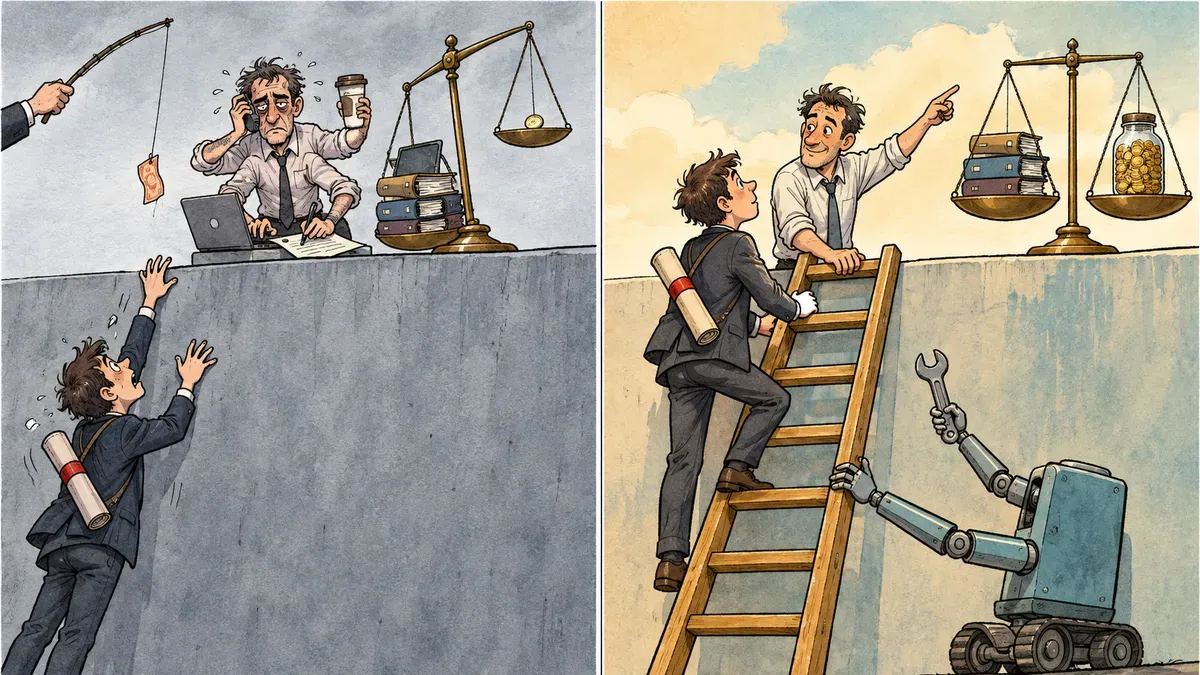
The missing rung
At Stanford, a group of researchers tracks the payrolls of millions of American workers month by month. In the jobs most exposed to AI, such as software development or customer service, there are now almost one in five fewer 22-to-25-year-olds than there would be if they had grown in line with their peers in other occupations.4 For more experienced workers there’s no comparable gap. And it isn’t about layoffs: companies are simply hiring fewer people who are starting out. The authors themselves stress that this is not proof of cause and effect, and for Italy I couldn’t find reliable data. In human terms, these are young people who trained for a trade and can’t find the first place to learn it.
In Europe the picture is less clear-cut. In France, a study by HEC Paris and the Banque de France covering every private-sector hire found that between late 2022 and March 2026 permanent hires of 21-to-29-year-olds in the most AI-exposed jobs fell by 28%, against 7.5% elsewhere, and by about 42% among young developers.5 Across the euro area the ECB sees youth employment in IT down by almost a fifth since 2023, but doesn’t attribute it to AI,6 while Eurofound, looking at the whole of the EU, finds no shock hitting young people in particular.7 The signals are there, but they aren’t proof yet.
In Italy, though, the first rung was missing long before. Entry-level job ads that ask for experience, internships that never turn into a contract and starting salaries that don’t cover the rent were not invented by AI. The answer of whole generations, mine included, was to leave. According to CNEL, Italy’s national council for the economy and labour, about 630,000 young people aged 18 to 34 moved abroad between 2011 and 2024, and in recent years more than four in ten had a degree.8
The South loses them twice, to other countries and to the North. According to Svimez, the institute that studies the economy of southern Italy, about 175,000 people aged 25 to 34 left the South between 2022 and 2024: almost three in four settled in central and northern Italy, the rest went abroad, and half had a degree.9
For fifteen years, when the first rung wasn’t here, you could go and look for it elsewhere, in London, Berlin or Zurich. The Stanford data are American and the French data cover a single country, but they concern the same jobs many of those young Italians went abroad to do: if the opportunity shrinks there too, leaving won’t be enough anymore.
A department in one person
Experienced people are better off, but only up to a point. With agents, one person does alone the work they used to share with a team, and becomes a whole department: they hold the project, the technical choices, the review of what the machines produce and the deadlines.
Pay doesn’t follow. In the United States, median pay for a senior engineer rose by about 4% in 2025, just above inflation.10 Italy is worse off: according to the International Labour Organization, real wages are still almost nine points below 2008, the largest loss among G20 countries.11 The South is worse still. According to Svimez, real wages in southern Italy fell by more than 10% between 2021 and 2025, against 8% in the centre and north, and almost one southern worker in five is poor despite having a job, three times the rate elsewhere in the country.9 In thirty years no government, of any political colour, has managed to turn this around.
The workload, on the other hand, keeps growing. Two Berkeley researchers spent eight months observing an American company where everyone had access to AI: the working day stretched, often without anyone asking, and work crept into the breaks, into lunch, the minutes before meetings, the evening.12 It’s the same mechanism I wrote about in AI does not need to wait, but we do: the time saved on execution doesn’t come back to us, it moves onto our attention. If pay rises a little and fatigue a lot, you have to wonder how long this pace can last.
Who gains
Products ship sooner and, as in every gold rush, those who gain most are the ones selling the shovels: the providers of models, chips and computing power, a table very few people sit at. Next come the companies and professionals who sell a result rather than their hours, because they produce more with less. Employees get the leftovers, whatever companies decide to leave them.
And since the great majority of people live on a salary, in a country where real wages have been losing ground for more than thirty years13 AI doesn’t create the imbalance: it finds it and speeds it up. So much for democratisation.
The consequence is that the ways out are changing, and not only for the young. Experienced people used to stay put; now they’re moving too. Some leave: the Fondazione Migrantes, which tracks Italian emigration, reports that whole families with school-age children are leaving Italy more and more often.14 Others go independent, because the same leverage that turns them into a department also lets them work for themselves and keep the result. According to Istat, Italy’s national statistics office, in the first quarter of 2026 the number of self-employed workers grew by 4.7% year on year, the only category on the rise, while employees fell.15 That figure contains a bit of everything, including self-employment that is independent in name only, and nobody attributes it to AI. According to Exploding Topics, worldwide searches for “solopreneur” have also grown by almost 90%: that isn’t research on the phenomenon, just a sign of interest, but it points the same way.16
Those who stay soldier on under stress towards a pension that comes later and is worth less. According to projections by Italy’s State General Accounting Office, a private-sector employee retiring from 2040 with 38 years of contributions will receive around 60% of their last gross salary, against more than 70% for those retiring now, and less still with a patchy career.17 My own simulation on the website of INPS, Italy’s social security agency, comes out at just under half of my last salary. It’s no coincidence that since 2026 new private-sector hires are automatically enrolled in a supplementary pension fund unless they opt out, and pay into it out of their own pocket too.18 In none of these cases, though, is anyone helping a junior grow.
Thirty years to notice
The problem of the disappearing rung isn’t new, and it has had a name for more than forty years. In 1983 the psychologist Lisanne Bainbridge described it in a now-famous paper, Ironies of Automation: if you automate the routine, the people supervising the system are left with only the hard cases, the very ones that would need the practice the routine used to give them.19
Aviation took it seriously, in its own time: thirty years after the paper, in the field where a mistake costs lives, the US Federal Aviation Administration recommended that airlines have pilots fly by hand more often. The data showed more errors in manual flying, and constant use of the autopilot risked weakening precisely the ability to take back control when something goes wrong.20 In practice, it chose to keep alive, on purpose, a job the machine could do, because that was where people learned.
In knowledge work the same choice costs far more. An agent finishes in a few minutes what takes a beginner several days, so keeping work done by hand alive means paying days of salary to learn what the machine does before you’ve finished your coffee. A company under pressure is unlikely to do it on its own initiative.
Not all companies move at the same pace, though. Some arrive late: there are firms full of young people, growing fast, that only budgeted for their first paid agent this autumn, simply because they didn’t want to spend. A company has to stay competitive, and those who lag behind on AI create their own problems. Those who adopt early gain an advantage, and that advantage is exactly what could pay for training the people who are starting out.
Here too it could be done in steps: start with small tasks done by hand, then move on to reviewing what the agent produces alongside someone experienced, then write the first rules for the agent, and only at the end make design choices, on a piece small enough to live with the consequences. I’ve never seen it applied and haven’t tried it myself, so it remains a hypothesis.
Who signs
At this rate software will be designed and written by agents and checked by other agents, and today’s race risks being this: pouring what seniors know into the models before they retire. Every correction written into an agent’s instructions is part of that transfer. But one thing doesn’t transfer, and that’s responsibility.
In July 2025 the agent on Replit, a platform for coding with AI, deleted a user’s production database despite being told not to touch anything. The response was an apology from the CEO and a few extra safeguards.21 So far, when an agent gets it wrong, that’s more or less how it has gone. In Europe things are about to change: under the new directive on liability for defective products, for everything placed on the market from 9 December this year software and AI systems also count as products, and whoever sells them is liable for the damage their defects cause to people, even without fault and even when the defect comes from a missing update.22 Whether an agent wrote the code doesn’t change who pays.
So someone will have to sign, and to sign you need to be able to judge. Not the style of the code, which is the easy part, but the whole life of a system: how it’s designed, whether it holds up as it grows, what happens when it breaks, how it gets fixed, how it gets updated and how you add features without breaking the rest. It’s knowledge built by getting real projects wrong, for years: Cal Newport, in So Good They Can’t Ignore You, calls it career capital, rare skills that only build up through years of deliberate practice.
A system nobody knows from the inside becomes a black box even if the code is there to read, and a black box isn’t maintained, it’s kept standing by trial and error. It’s Robert Pirsig’s friend in Zen and the Art of Motorcycle Maintenance, who doesn’t want to understand his motorcycle and always depends on someone else to fix it.
When the last people who learned the trade from the bottom rung retire, who will really be able to judge a system?
Footnotes
-
Stack Overflow, 2025 Developer Survey, AI section. https://survey.stackoverflow.co/2025/ ↩
-
Epoch AI, LLM inference prices have fallen rapidly but unequally across tasks, 12 March 2025. https://epoch.ai/blog/llm-inference-price-trends ↩
-
The Next Web, Token prices fell 98%, enterprise AI bills tripled, 2026, with Jellyfish data on consumption per developer. https://thenextweb.com/news/token-prices-fell-98-enterprise-ai-bills-tripled-now-the-industry-wants-a-standards-body-to-explain-why ↩
-
E. Brynjolfsson, B. Chandar, R. Chen, Canaries in the Coal Mine? Six Facts about the Recent Employment Effects of Artificial Intelligence, Stanford Digital Economy Lab, revision of 12 August 2026, ADP data up to June 2026. https://digitaleconomy.stanford.edu/publications/canaries-in-the-coal-mine ↩
-
A. Bergeaud, A. Bertheau, S. Bunel, O. Degos, M. G. Palladino, HEC Paris and Banque de France study on hiring of young people in AI-exposed jobs, 2026. https://www.hec.edu/en/dare/tech-ai/private-french-firms-hire-fewer-young-workers-ai-exposed-jobs ↩
-
ECB, Youth employment amidst cooling labour demand, Economic Bulletin 5/2026, 6 August 2026. https://www.ecb.europa.eu/press/economic-bulletin/focus/2026/html/ecb.ebbox202605_04~faa9ef5955.en.html ↩
-
Eurofound, AI is already in use in Europe’s workplaces, but not at the expense of young workers, 2026. https://www.eurofound.europa.eu/en/publications/all/ai-is-already-in-use-in-europe-s-workplaces-but-not-at-the-expense-of-young-workers ↩
-
CNEL, report on Italy’s attractiveness to young people from advanced countries, as reported by Avvenire on 6 January 2026 (in Italian). https://www.avvenire.it/economia/lavoro/sono-630mila-gli-italiani-espatriati-in-13-anni_102851 ↩
-
Svimez, Rapporto 2025 sull’economia e la società del Mezzogiorno, press release (in Italian). https://www.svimez.it/wp-content/uploads/2025/11/svimez_comunicato_stampa_2025.pdf ↩ ↩2
-
Levels.fyi, End of Year Pay Report 2025. https://www.levels.fyi/2025/ ↩
-
ILO, Global Wage Report 2024-25, as reported by ANSA on 24 March 2025. https://ansa.it/amp/english/news/2025/03/24/italian-real-wages-down-8.7-points-with-respect-to-2008-ilo_12411eca-75df-446d-bcdb-6f1f5c5ef6ee.html ↩
-
X. M. Ye, A. Ranganathan, AI Doesn’t Reduce Work, It Intensifies It, Harvard Business Review, February 2026. https://newsroom.haas.berkeley.edu/ai-promised-to-free-up-workers-time-uc-berkeley-haas-researchers-found-the-opposite/ ↩
-
Italian Parliamentary Budget Office (UPB), analysis of real wages since 1990, as reported by L’Espresso on 21 July 2026: -6.6% in real terms (in Italian). https://lespresso.it/c/economia/2026/7/21/salari-reali-italia-2026-1990-ufficio-parlamentare-di-bilancio/63576 ↩
-
Fondazione Migrantes, Rapporto Italiani nel Mondo 2025, as reported by AGI on 12 November 2025 (in Italian). https://www.agi.it/cronaca/news/2025-11-12/famiglie-intere-pronte-a-trasferirsi-all-estero-34136898/ ↩
-
Istat, Il mercato del lavoro, I trimestre 2026, press release of 12 June 2026 (in Italian). https://www.istat.it/comunicato-stampa/il-mercato-del-lavoro-i-trimestre-2026/ ↩
-
Exploding Topics, “Solopreneur” page: online search trend, not a study. https://explodingtopics.com/topic/solopreneur ↩
-
Italian Ministry of Economy and Finance, State General Accounting Office (RGS), Le tendenze di medio-lungo periodo del sistema pensionistico e socio-sanitario, Report no. 26 (2025), chapter 6, gross replacement rates in the baseline scenario (in Italian). https://www.enpap.it/DOC/RIFORMA_PREVIDENZIALE/MEF_RAPPORTO-2025-N.26_CAPITOLO-6.PDF ↩
-
2026 Budget Law, automatic enrolment of new private-sector hires in supplementary pension schemes, summary by PartitaIVA.it (in Italian). https://www.partitaiva.it/tfr-previdenza-complementare-adesione-2026/ ↩
-
L. Bainbridge, Ironies of Automation, Automatica 19(6), 775-779, 1983. https://doi.org/10.1016/0005-1098(83)90046-8 ↩
-
Federal Aviation Administration, SAFO 13002: Manual Flight Operations, 4 January 2013. https://www.faa.gov/sites/faa.gov/files/other_visit/aviation_industry/airline_operators/airline_safety/SAFO13002.pdf ↩
-
Fortune, AI coding tool Replit wiped database, called it a catastrophic failure, 23 July 2025. https://fortune.com/2025/07/23/ai-coding-tool-replit-wiped-database-called-it-a-catastrophic-failure ↩
-
Directive (EU) 2024/2853 on liability for defective products. https://eur-lex.europa.eu/eli/dir/2024/2853/oj ↩